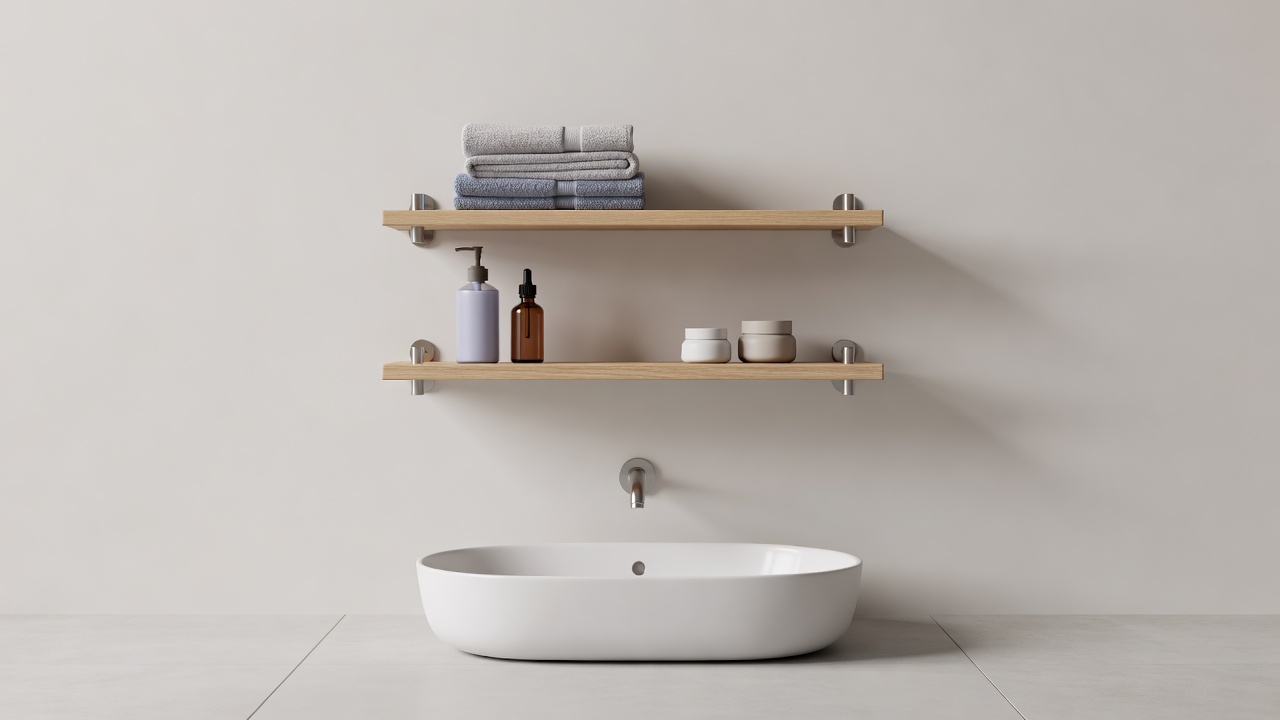
Separate a humid room from a wet position
Begin by identifying where water actually lands. A position inside a shower, a shelf beside a tap and a unit across a ventilated room have different exposure conditions. “Bathroom storage” is a category label, not a promise that every surface, joint and fixing tolerates direct spray. Read the manufacturer's intended-use statement and care instructions for the exact product.
Look at edges, undersides, shelf supports and fasteners as well as the visible finish. A coated surface can still have vulnerable cut edges or joints. Stainless steel is not a single universal corrosion specification, and a powder-coated frame is not automatically immune to damage. Avoid translating a material name into a waterproof claim unless the manufacturer explicitly supports that use.
Ventilation and cleaning remain room-level tasks. A new shelf does not fix condensation, persistent damp or a leak. Keep access to ventilation openings and service points, and resolve the underlying moisture problem before placing furniture against an affected wall. Ask an appropriate professional where building conditions are uncertain.
Give the kitchen working space, not just storage
Measure what will sit on a rack, including pan handles, jar lids and appliance cords. Check internal shelf dimensions and the space above the object. A mixer that fits while stored may need substantially more room to operate, and an appliance's instructions may prohibit operation in an enclosed or tightly shelved position. A shelf is not automatically an appliance stand.
Plan around heat and splashes using the appliance maker's requirements and relevant local rules. Do not select a distance from a cooker simply because it looks balanced in a photograph. Keep controls, sockets and ventilation accessible. Route no cable across a hot surface or through a furniture modification that the manufacturer has not approved.
Open kitchen racks are easy to scan, but stored items can collect grease and dust. Choose a layout you can realistically empty and clean. Closed storage can reduce visible clutter, yet doors need an opening arc and interiors still need attention. Baskets help group packets, provided they fit without projecting into the working route or concealing spills.
Compare the complete working depth
A nominal 30 cm-deep shelf may project farther once a basket handle or pan extends beyond its edge. Mark the furthest projection, not just the frame, when testing the aisle. This is a fit check—not a universal kitchen clearance standard.
Work around pipes and moving parts
Under-basin storage is shaped by the trap, supply pipes, valves and the basin's underside. Measure at several heights and allow access for inspection and maintenance. A removable shelf may be useful only if it can actually be removed once the unit is installed. Do not cut a structural panel or conceal a service point simply to achieve a flush appearance.
Over-toilet units require more than a width measurement. Check the cistern lid, flush control, seat movement and maintenance access. A rack that spans the fixture may still need wall restraint. Keep frequently used items reachable without leaning awkwardly over fittings, and avoid storing objects where a fall could damage fixtures or obstruct use.
For towels, compare the shelf opening with the folded stack you use at home. Leave space for air circulation where the product and room conditions require it, and do not put damp textiles into enclosed storage. For cleaning products, follow the product label, keep original containers and consider child-access risks. Open display shelving is not suitable for every household's contents.
Treat tile as a surface, not the whole wall
The material behind the tile helps determine the fixing method. Drilling can also affect waterproofing and may encounter concealed pipes or cables. Use qualified help where the construction, service locations or waterproofing details are unclear. A decorative tile face alone does not establish what a shelf can carry.
Adhesive and suction products have their own limits for surface type, preparation, curing, environment and loading. They are not general substitutes for required mechanical fixings or furniture restraints. Do not borrow a capacity claim from a different accessory. A tension-mounted unit likewise depends on its specified surfaces, dimensions and installation method.
- Confirm whether the precise location is within the product's intended use.
- Measure pipes, controls, doors and maintenance access.
- Check cleaning instructions for the finish and all components.
- Establish the substrate and any waterproofing constraints before drilling.
- Follow the stated loading, mounting and restraint requirements.
IKEA RÅGRUND and VESKEN, OXO storage products and simplehuman organizers are recognizable research examples, not endorsements or proof of suitability for a wet location. Compare the specific item, dimensions and current instructions. The strongest choice is the one whose documented conditions match the position you have—not the one styled most convincingly beside a bath.