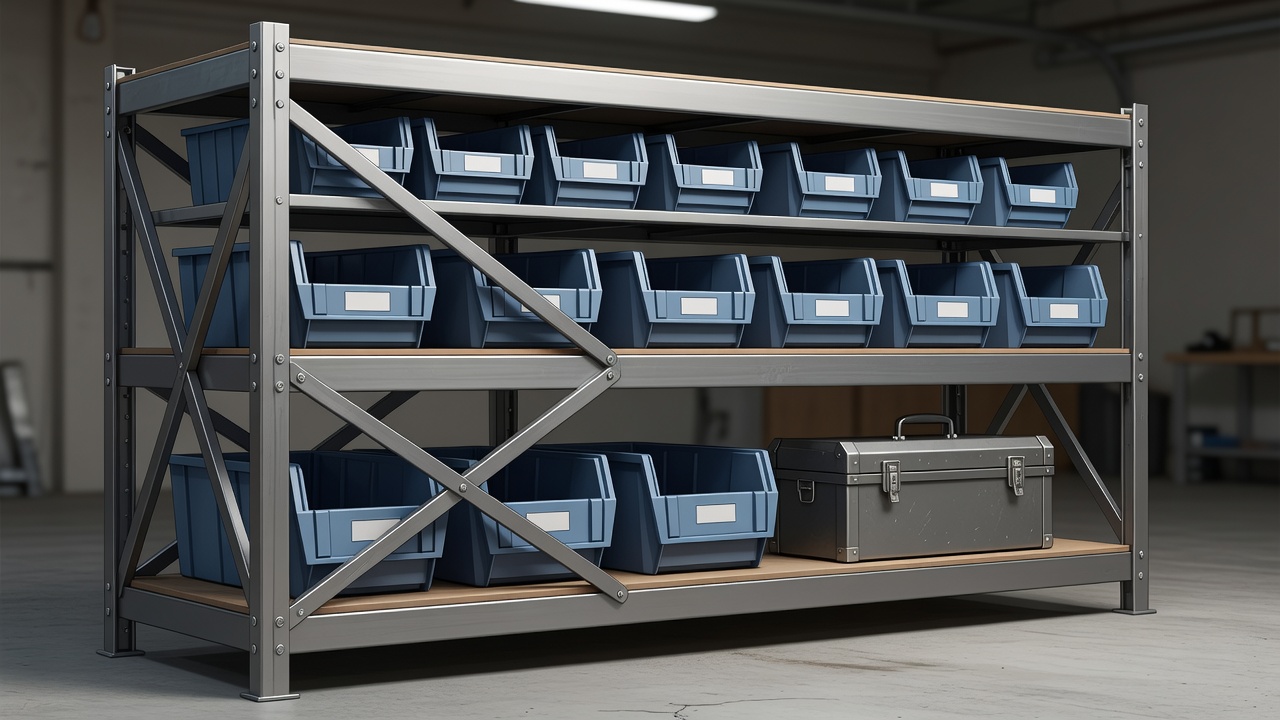
Size the rack around real containers
Begin with the containers you already use. Measure the widest point, including lids, handles and latches. A bin's advertised capacity describes volume, not the footprint it needs on a shelf. Two containers that appear to fit across a rack may collide with uprights, braces or one another when you try to remove them.
Record the usable opening between uprights and the clear height between shelves. External width includes the frame; external depth may include parts that do not support the container base. Leave the handling space needed to grasp a lid and lift a loaded box without tilting it into the shelf above. A fit that works only when the bin is empty is not a useful fit.
Map the surrounding room too. In a garage, account for vehicle doors, service equipment and the path to the exit. In a laundry area, retain access to appliance hoses, filters and controls. Keep manufacturer-specified clearances around heaters and other equipment. Do not use a storage plan to justify blocking an escape route or access point.
Understand what the label actually permits
Read shelf capacity and whole-unit capacity separately. A rating may assume a uniformly distributed load, a particular shelf spacing, all components installed and the rack positioned on a suitable surface. The same family can contain several widths and deck materials with different limits. Use documentation for the exact model and configuration.
For a hypothetical example, five shelves labelled 40 kg each do not independently prove that the assembled unit can carry 200 kg. The manufacturer must specify the unit limit and relevant conditions. Likewise, a 40 kg distributed-load rating does not mean a single 40 kg object can be placed at the centre. These numbers illustrate how to read labels; they are not proposed storage limits.
| Published information | What to check | What not to assume |
|---|---|---|
| Per-shelf rating | Exact span, deck type and loading pattern | Every point on the surface accepts that weight |
| Whole-unit rating | Required configuration, braces and installation | It equals the sum of all shelf labels |
| Mobile rack rating | Whether the figure applies while moving or stationary | Castors preserve the fixed-rack limit |
| Wall-system rating | Wall substrate, rail spacing, brackets and fixings | The brackets alone establish installed capacity |
Keep dense items where they can be handled without overreaching, while following the manufacturer's loading arrangement. Lower placement can reduce difficult lifting but is not a substitute for required anchoring. Split awkward loads into manageable containers where practical. A domestic shelving guide cannot assess your lifting ability or certify a workplace storage scheme.
Match the deck to the room conditions
A utility room can be dry and heated, while a garage may experience condensation or occasional damp. Check the stated use environment for both frame and deck. A coated metal frame does not make an absorbent board shelf waterproof. Wire decks allow airflow but may need approved liners for small objects; adding an improvised panel can change loading and moisture behaviour.
Inspect the floor before choosing a tall rack. Slope, damaged surfaces and soft coverings can affect installation. Adjustable feet are useful only within the maker's permitted adjustment and floor conditions. Do not improvise levelling with loose scraps or alter the frame. If the surface or structure is uncertain, obtain suitable professional advice before loading.
IKEA BROR and OMAR, Rubbermaid FastTrack and Metro shelving are examples of distinct storage families worth researching for their current specifications. Their names do not establish suitability for a damp garage, a particular load or your wall. Compare the exact product documents rather than treating “garage,” “industrial” or “heavy duty” as a technical rating.
Budget for the complete installation
The purchase price may exclude suitable fixings, delivery, liners or assembly. Boltless construction still requires every connection to be seated as instructed; bolted frames require the specified hardware and tightening method. Never omit a brace to fit an oversized box. Keep instructions accessible so the system can be checked after moving or reconfiguring.
- Confirm the intended environment and exact rack dimensions.
- Verify both shelf and whole-unit limits in the product documentation.
- Identify required restraints and a suitable anchoring location.
- Check the floor, all connections and shelf seating before loading.
- Reassess after damage, a move or a change of configuration.
For background on workplace storage responsibilities, the UK's Health and Safety Executive publishes general guidance. For domestic furniture hazards, the U.S. Consumer Product Safety Commission offers consumer resources. Neither source turns a household rack into certified workplace equipment. Where a project falls outside ordinary home use, get advice appropriate to the premises and jurisdiction.